2026
UnitedMasters helps independent artists distribute and own their music. I lead design on the growth and monetization team, finding new ways to turn our audience into revenue.
Web Design
ARPU Growth
Project Details
Role
Design Lead, Growth & Monetization
Team
1 Design Lead, 1 Product Manager, 1 Technical Project Manager, 1 Data Scientist, 1 Tech Lead, 3+ Software Engineers
Tools Used
Claude Design, Claude Cowork, Figma, Figma AI, Jira/Confluence, Amplitude
Experience Gained
Designed inside a rigorous experimentation culture, scoping every feature to a two-week sprint and shipping it as a 50/50 A/B test against control. Translated raw technical output into human-legible copy and built handoff systems, including a response-to-copy mapping table, that left engineering zero ambiguity, treating guardrail metrics as design constraints rather than afterthoughts.
Intro

The Problem
Audio Quality No One Could Evaluate.
Mastering was already live in the distribution flow as a paid add-on, but it read as an abstract line item and most artists skipped it.
My hypothesis: they weren't rejecting mastering, they were rejecting a purchase they couldn't evaluate. Nothing told them what was actually wrong with their track, so mastering had nothing concrete to fix.

How Mix Check Works
Show Them, Don't Sell Them.
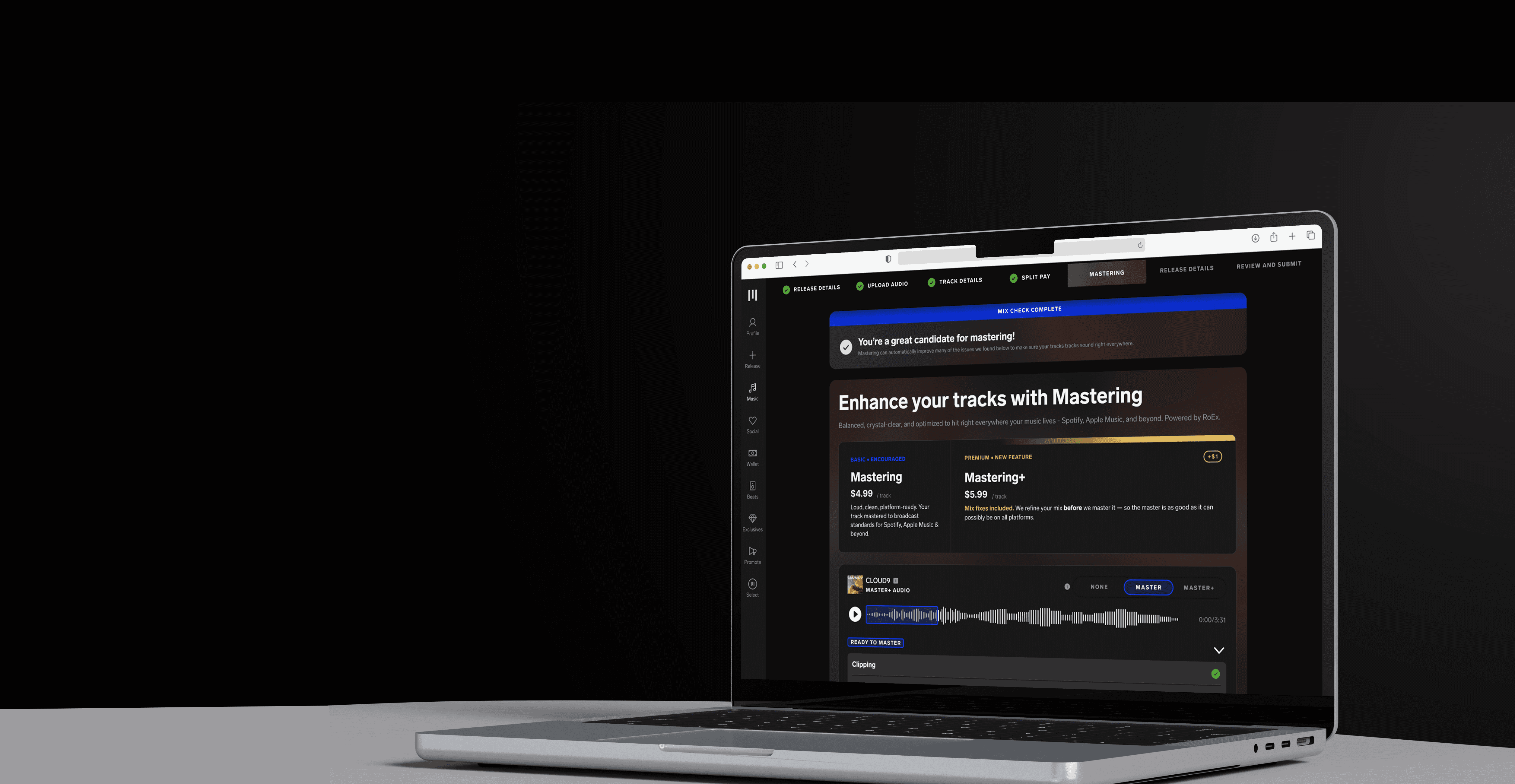
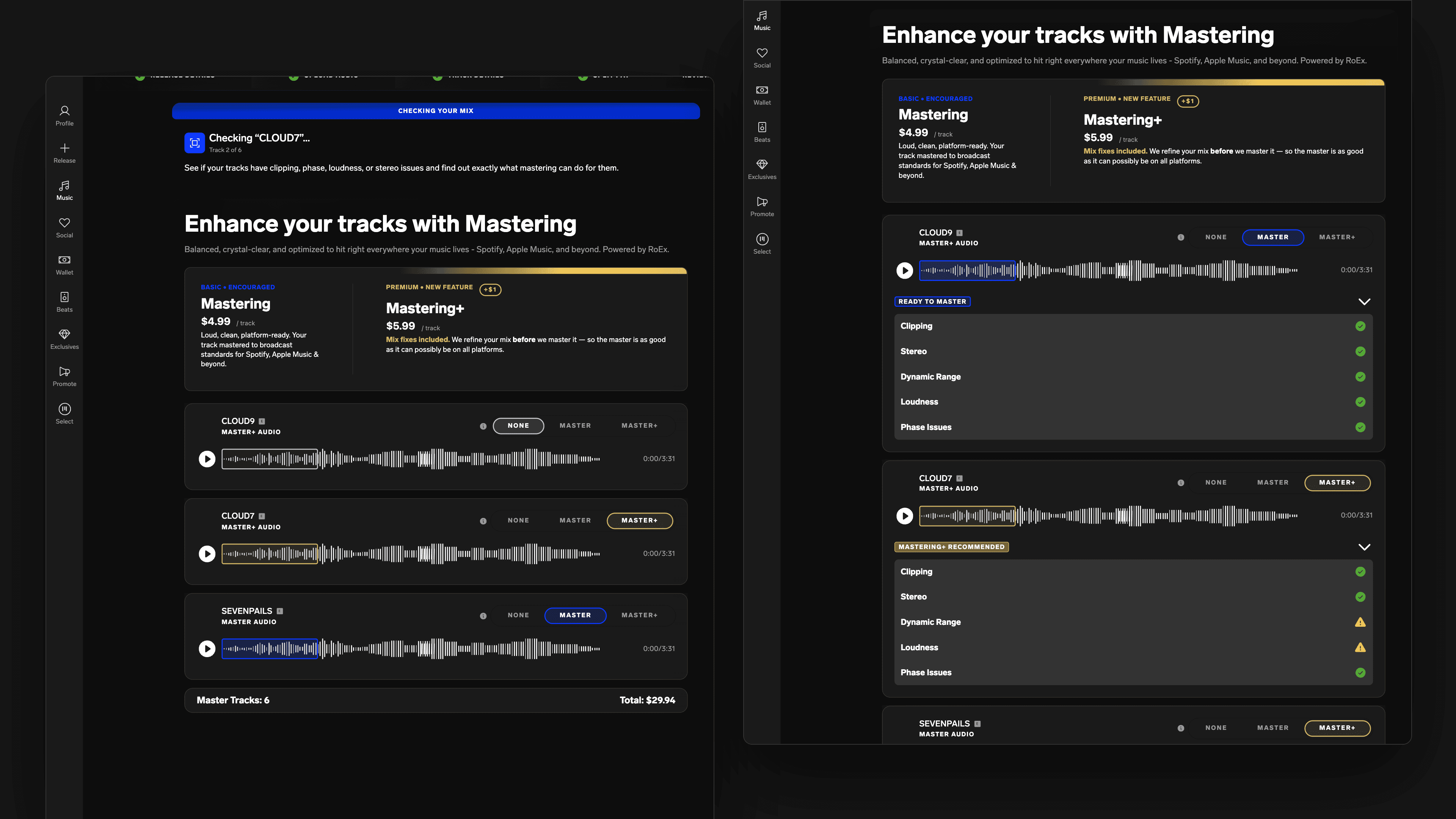
Mix Check scans every uploaded track across five technical dimensions, flagging which parts need help and how severe each issue is. Instead of an audio engineering report, artists get plain language: what's working, what isn't, and what to do about it. From there, Mix Check recommends a path forward.
The pitch shifts from "buy this because it's good practice" to "here's what your track needs."
Mastering+: For Bigger Fixes
A Fix Sized to the Problem.
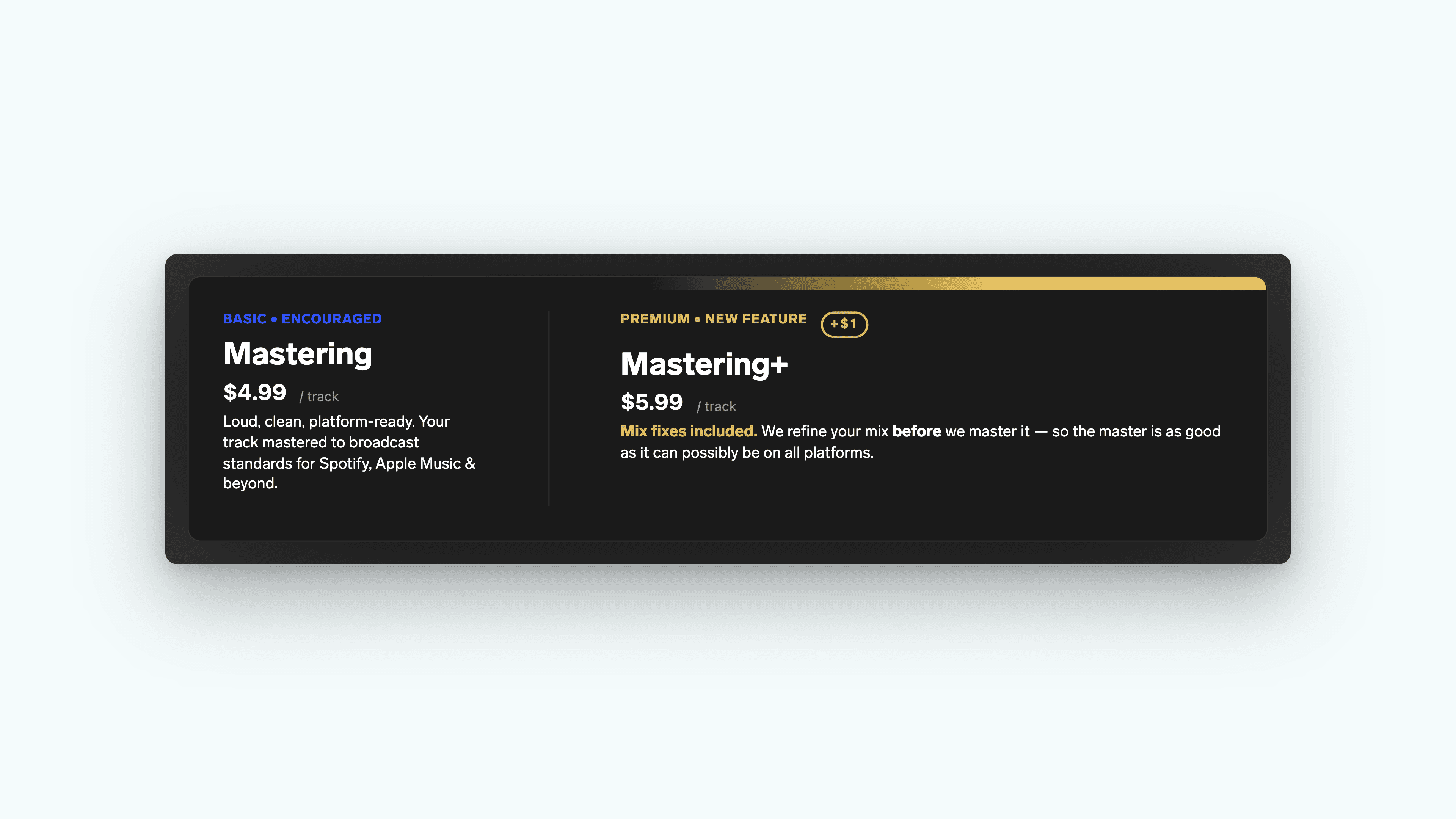
Alongside Mix Check, we added Mastering+, a more intensive fix for tracks that need more than a standard master, for just $1 more. Where standard Mastering polishes the final mix, Mastering+ improves the mix itself before mastering it. Artists with real problems in their tracks, not just tracks that were already close, finally had a tier that matched the size of their issue.
From Manual to Automatic
Results Before You Ask.
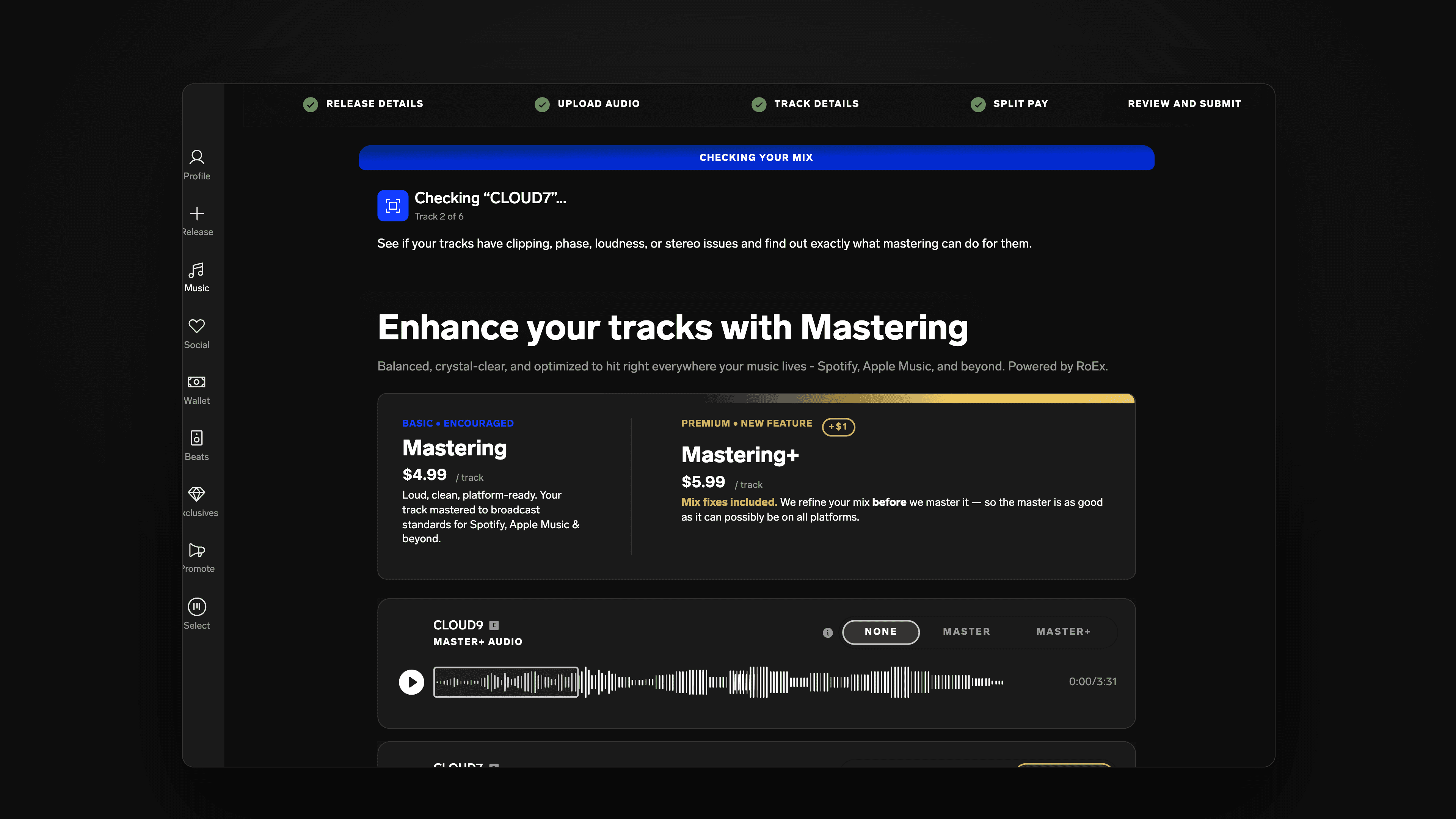
The first draft required artists to click a CTA and wait for Mix Check to run. The second draft runs it automatically the moment a track uploads, earlier in the flow, so results are in or nearly ready by the time artists reach the mastering section. Removing the click and the wait turned Mix Check from an extra step into something that felt already done for them.
Simplifying the Verbiage
Every Track Deserves To Be Mastered.
Mix Check originally surfaced three outcomes: no issues found, mastering recommended, Mastering+ recommended. Once we had usage data, we cut it to two: ready to master, and Mastering+ recommended. "No issues found" was misleading, since every track benefits from mastering, issues or not. Dropping it let "Mastering+ recommended" carry real weight as the signal that a track needs the bigger fix.
Constraints
Two Sprints, One Guardrail.
This shipped as a 50/50 A/B test against control, targeted to paying members on web and scoped to two sprints. The primary metric was mastering conversion rate. Completed release submissions ran as a guardrail, so we never grew conversion at the cost of the core flow.
Results, and What's Running
What Moved, and What's Still Being Tested.
Conversion up 19.3% across two shipped experiments.
Mastering+ lifted conversion to reach a 91.7% probability to beat control. Mix Check launched against that baseline and read 11.07%. All three secondary metrics up, guardrails steady, allocation clean. Sized as a launch check rather than a lift read, it gave us what we needed to ship.
26.2% of buyers came back within 30 days, across an upsell reaching 10.5–11.4K artists a week. Artists don't pay twice for mastering that didn't work. Automatic Mix Check and simplified messaging are in test now.